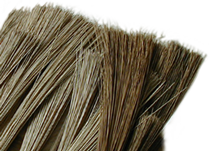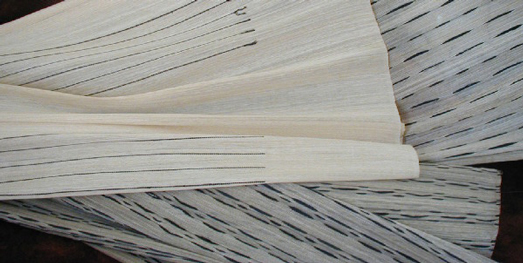
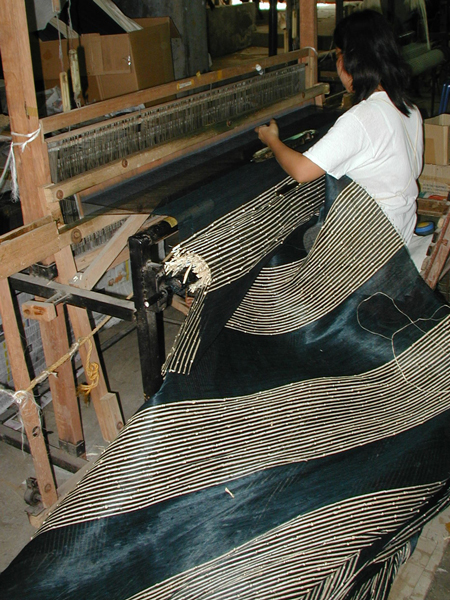
Abaca, also called Manila Hemp, derives from the textile banana plant and is renowned for its high tensile strength and durability. Prior to weaving, abaca fiber is beaten rhythmically by hand using traditional paddles for softening and to release the natural cellulose, resulting in a high silky luster and smooth, cool finish.
Bacbac, the bark-like dried outer leaf sheath of the abaca tree, is also used for design and textural definition.
Raffia fiber has a density which translates into fabric with a polished, satin-like hand. The fiber is extracted by hand from the unopened leaf of the African Raffia (or Buri) Palm, a slow-growing, wild palm species with very large, fan shaped leaves. The fibers, several feet long, are split into strands of differing dimensions, and hand-knotted prior to weaving.